SKY·PHAGENorse ský, cloudLatin -phagous, to devour
Reimagining the internet, where users own the infrastructure.
Enough of the hyperscalers. It's time for the people to run the internet. SkyPhage is harboring the next-generation of cloud platforms, where anyone can be paid to contribute infrastructure to a resilient, self-healing network where everyone benefits. Use your compute, or someone else's.
The town should be owned by the town.
- phage-7f3a9cShed, Stockport · Pi 5serving hello-api
- phage-b21e44Garage, Dublin · OptiPlexserving emoji-vote
- phage-44ab10Space Heater rack, Frankfurtserving llm-eval · Gold
- phage-3c19d2Loft, Edinburgh · NUCserving chat-relay
- phage-a07e5bCupboard, London · Mac miniserving hello-api
- phage-5d2c81Spare room, Bristol · ThinkCentreserving image-resize
- phage-e914c0Garage, Belfast · MicroServerserving emoji-vote
- phage-2b6f97Shed, Cork · Pi 4serving weather-cache
- phage-c81d0aBasement rack, Amsterdam · EliteDeskserving md-render · Gold
Write inRust · Go · JavaScript · Python · C/C++ · anything that compiles to wasm32-wasip1
Host onRaspberry Pis · old desktops · NAS boxes · hypervisor VMs · rack servers · GPUs
The internet has a centralisation problem
Today's web is dominated by a few hyperscale cloud providers. Your data, your applications and your business all depend on infrastructure you don't control. Outages cascade globally. Costs keep rising. And billions of compute resources sit idle around the world. We're changing that.
- 3
- cloud providers control over 65% of all internet infrastructure
- 85%
- of server capacity worldwide sits idle at any given moment
- 1
- point of failure can take down millions of websites and services
Be part of the new internet
Whether you have spare compute, need distributed execution, or just want to build without limits.
fn main() {
    let port = phage::get_port(8080);
    phage::http::listen(port).expect("failed to listen");

    loop {
        if let Some(req) = phage::http::accept() {
            let body = format!("Hello! You requested: {}", req.path);
            phage::http::respond(200, "text/plain", body.as_bytes());
        }
    }
}
package main

//go:wasmimport env phage_http_listen
func phageHttpListen(port int32) int32

//go:wasmimport env phage_http_respond
func phageHttpRespond(
    status int32,
    ctypePtr *byte, ctypeLen int32,
    bodyPtr *byte, bodyLen int32,
) int32

func main() {
    phageHttpListen(8080)
    body := []byte("Hello from Go on SkyPhage!")
    ctype := []byte("text/plain")
    phageHttpRespond(200,
        &ctype[0], int32(len(ctype)),
        &body[0], int32(len(body)))
}
// Compiled to WASM with the Javy toolchain.
// The runtime passes the request on stdin and reads the response from stdout.
const request = JSON.parse(readInput());

const response = {
    status: 200,
    headers: { "Content-Type": "application/json" },
    body: JSON.stringify({
        message: "Hello from JavaScript on SkyPhage!",
        path: request.path,
        timestamp: new Date().toISOString(),
    }),
};

writeOutput(JSON.stringify(response));
import json

def handle_request(request):
    """Handle an incoming HTTP request."""
    path = request.get("path", "/")
    method = request.get("method", "GET")

    if path == "/":
        return {
            "status": 200,
            "content_type": "application/json",
            "body": json.dumps({
                "message": "Hello from Python on SkyPhage!",
                "method": method,
            }),
        }
    return {"status": 404, "content_type": "text/plain", "body": "Not found"}
Compute flows to where it's needed
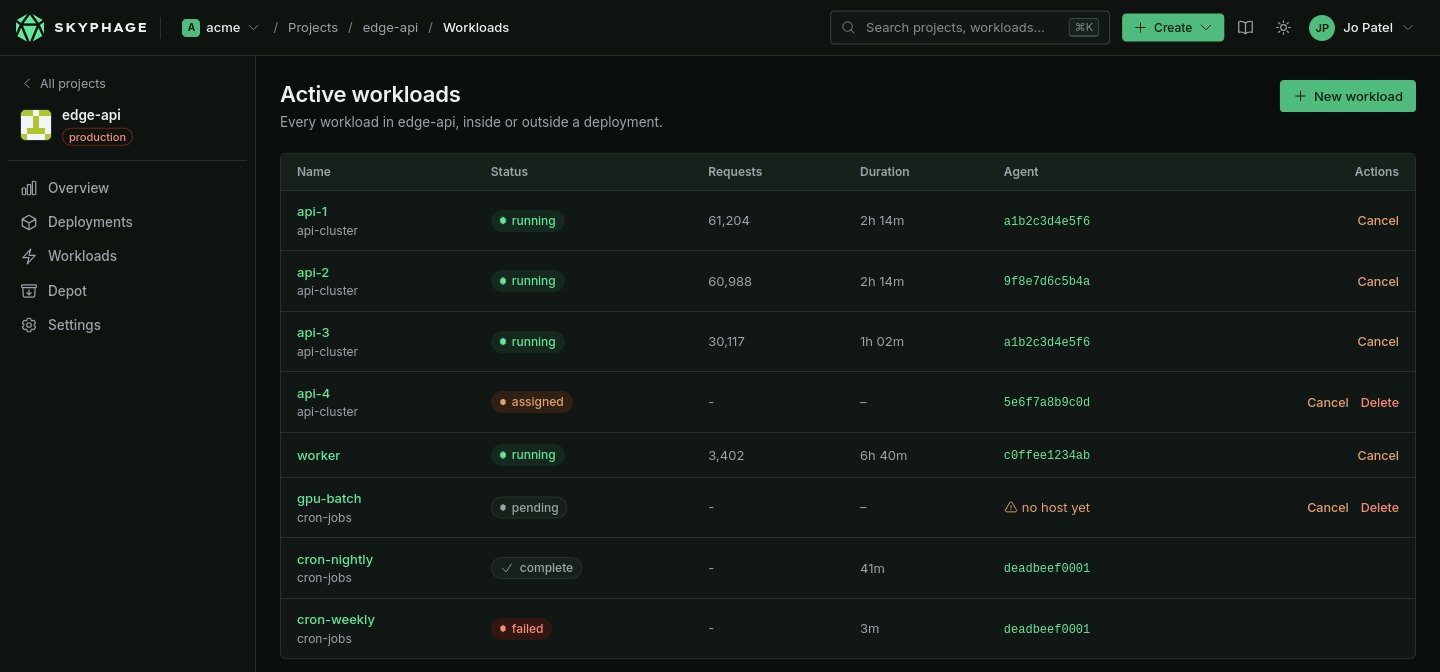
Every host carries a location and a reliability score it earned. A workload lands on the nearest host that can be trusted with it, is watched while it runs, and moves the moment that stops being true.
- schedulerhello-api needs 128 MB · 0.5 vCPU · near Manchester. Scoring 4 candidates.
- schedulerphage-7f3a9c Shed, Stockport 12 km rel 0.98 chosen
- schedulerphage-9d8e7f Office, Leeds 60 km rel 0.91
- schedulerphage-b21e44 Garage, Dublin 265 km rel 0.97
- schedulerphage-5e6f7a Shelf, Newcastle 180 km rel 0.72
- phage-7f3a9cserving at https://hello-api-acme.phage.cloud · heartbeat 12 ms
- monitor1.2k requests/min · p50 14 ms · 0 errors
- monitorphage-7f3a9c missed 3 heartbeats
- schedulerreassigning hello-api → phage-b21e44 (Garage, Dublin)
- phage-b21e44serving at https://hello-api-acme.phage.cloud · heartbeat 48 ms
- reputationphage-7f3a9c back online · reliability 0.98 → 0.93
A fundamentally different architecture
Traditional cloud stacks were designed for a world of walled gardens. SkyPhage was built from the ground up for a distributed, open future.
| Placement | Geo-aware orchestrationA modified haversine routing places workloads on the nearest reliable host, weighing hops, latency, distance, reliability and free capacity in real time.distance · hops · latency · reliability · capacity |
|---|---|
| Isolation | WASM sandboxingEvery workload runs in its own WebAssembly sandbox on Wasmtime. Memory-safe, capability-restricted, hardware-agnostic. No containers required.wasmtime · wasm32-wasip1 |
| Trust | Reputation, not authorityHosts earn scores over time. Higher reliability attracts more workloads; bad actors are deprioritised automatically.+rep per success · −rep per failure |
| Networking | Zero configurationAutomatic TLS, NAT traversal and a public HTTP gateway. Workloads are reachable the moment they deploy.TLS · STUN · UPnP · <workload>-<org>.phage.cloud |
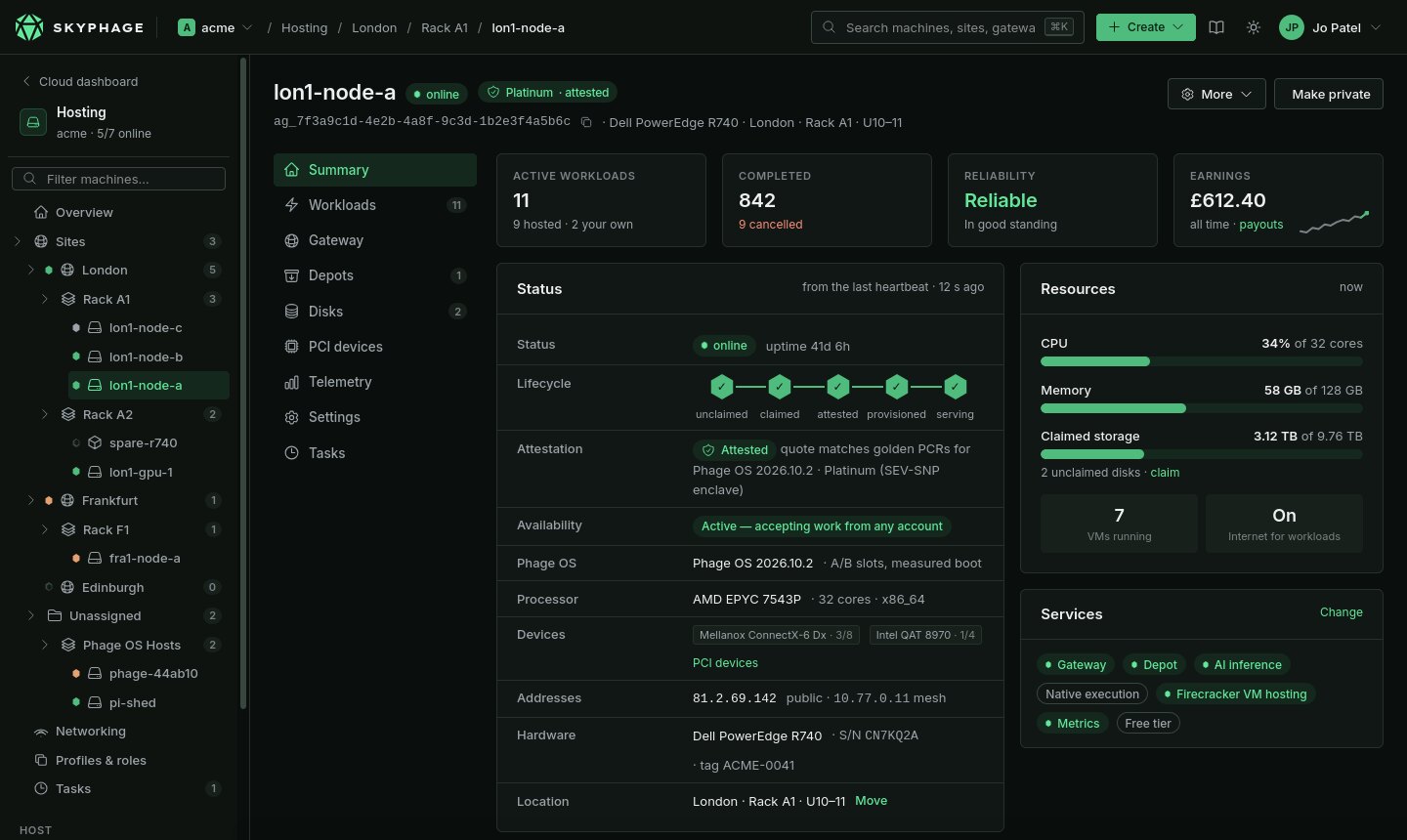
| Confidentiality | Attested confidential computeHosts with SEV capability are attested when they are claimed and badged by tier, so a sensitive workload can insist on an enclave it can verify.Platinum SEV-SNP · Gold SEV-ES · Bronze SEV |
| Services | Components built inHost-provided services any workload can call from any SDK. No sidecars, no managed add-ons to provision.http · kv · cache · crypto · state · peers · wasd · phsql |
Turn the hardware you already own into income
GPUs and bandwidth become a revenue stream while strengthening the open network.
- 1Boot Phage OSWrite the image to a USB stick or PXE-boot it. Immutable, signed, updated A/B. Your boot disk is never offered to anyone.
- 2Type the code into your dashboardThe machine lands in your "Phage OS Hosts" rack as a private, attested host. Move it to any site or rack later.
- 3Offer what you chooseDisks and PCI devices are opt-in, one at a time. Share a GPU as MIG slices or SR-IOV functions, or keep it exclusive.
   Add this machine to your account

     code   CDFG-HJKM
     go to  https://skyphage.com

   Sign in, open Hosting, and enter the code above.
   Nothing is hosted here until you do.
   Hosting

     address   192.168.1.42
     class     Gold    (SEV-ES)
     depot     enabled
     gateway   disabled

   Change what this machine offers from your
   dashboard, under Hosting.
$ cargo new hello-api && cd hello-api
    Creating binary (application) `hello-api` package
$ cargo add phage
      Adding phage to dependencies
$ cargo build --target wasm32-wasip1 --release
   Compiling hello-api v0.1.0 (/home/you/hello-api)
    Finished `release` profile [optimized] target(s) in 6.18s
$ ls -lh target/wasm32-wasip1/release/*.wasm
-rw-r--r-- 1 you you 1.8M Oct 26 14:02 hello-api.wasm
# upload hello-api.wasm to your project depot, then deploy
→ https://hello-api-acme.phage.cloud
From code to globally distributed execution in three steps
Compile to WASM, push, and let SkyPhage handle the rest. Ship globally in minutes.
- 1Compile to WASMBuild your application in any supported language. One artifact runs everywhere.
- 2Define requirementsResource needs, geo preferences and duration. Upload the binary to your project depot.
- 3SkyPhage orchestratesThe best available host runs it, monitors it and fails it over when it has to.
- Quickstart in Go, JavaScript or PythonDeploy a community application
Low-cost, reliable global compute without vendor lock-in
The machines already exist: validated hosts in homes, offices and racks, already switched on. SkyPhage runs your workloads on the reliable ones nearest your customers, moves them when a machine fails, and bills only what they use.
| Compared on | The hyperscalers | Colocation | SkyPhage |
|---|---|---|---|
| Up front | Nothing, then a bill that grows with every service you adopt | Land, power, hardware and the people to run it | Nothing. Top up a wallet and set a budget per workload |
| Metro datacenters | The regions on offer | Wherever you built it | Anywhere on the planet with an available CPU. On the hosts nearest your users, placed as demand moves |
| When a machine fails | Your architecture has to cope | Your on-call engineer has to cope | The scheduler moves the workload to the next reliable host |
| Under attack | Protection you configure and pay for | Scrubbing you build or rent | Nearby reliable hosts scrub the attack for you and provide a defence perimeter until the attack stops |
| Sensitive data | Their hardware, their attestation | Your hardware, your audit | Attested enclaves by tier: Bronze, Gold or Platinum |
| Leaving | Proprietary services to unpick | A building to sell | WASM and OCI. Take your artifacts anywhere |
| More capacity | Another data centre | Another data centre | More hosts and machines onboarded |
We left Big Tech to decentralise it.
Built by the humans who build the cloud
SkyPhage was founded by engineers who spent years building the infrastructure behind the world's largest hyperscalers. They have seen first-hand how centralised systems fail, and SkyPhage exists to give the internet back to the people who use it.
- Registered
- England and Wales
- Team
- UK and Ireland, remote
- Lock-in
- None, ever
- Runtime
- WASM + OCI
- 1Security above all elseEvery decision, every placement and every line of code is measured against the security and integrity of the network first.
- 2An orchestrator and a brokerWe connect demand to independent hosts with spare capacity, and coordinate that exchange rather than owning the infrastructure.
- 3We don't run your workloadsThey execute on the independent hosts that make up the network, not on machines we operate.